Model the journey at session grain
I transformed raw events into governed session, funnel, cohort, and customer-behaviour marts.
Product Analytics · Business Analysis
Conversion funnel, retention, and revenue-driver analysis that turns customer friction into testable action.
My approach
I transformed raw events into governed session, funnel, cohort, and customer-behaviour marts.
I used statistical tests and power checks without treating historical behaviour as proven uplift.
I specified five tests with hypotheses, primary metrics, guardrails, and decision rules.
Customer journey
The analysis separates browsing, high intent, and purchase behaviour.
Key insights
Observational evidence supports a test. It does not prove a causal effect.
Users added several products but did not purchase. Test: checkout reassurance.
Users explored many products but did not purchase. Test: product recommendation support.
The main friction appeared before the cart. Test: trust and delivery information.
Decision evidence
The views progress from behaviour to action and then to a measurable experiment.
Why this visual exists. Conversion is compared across cart, view, exploration, removal, and session-duration bands.
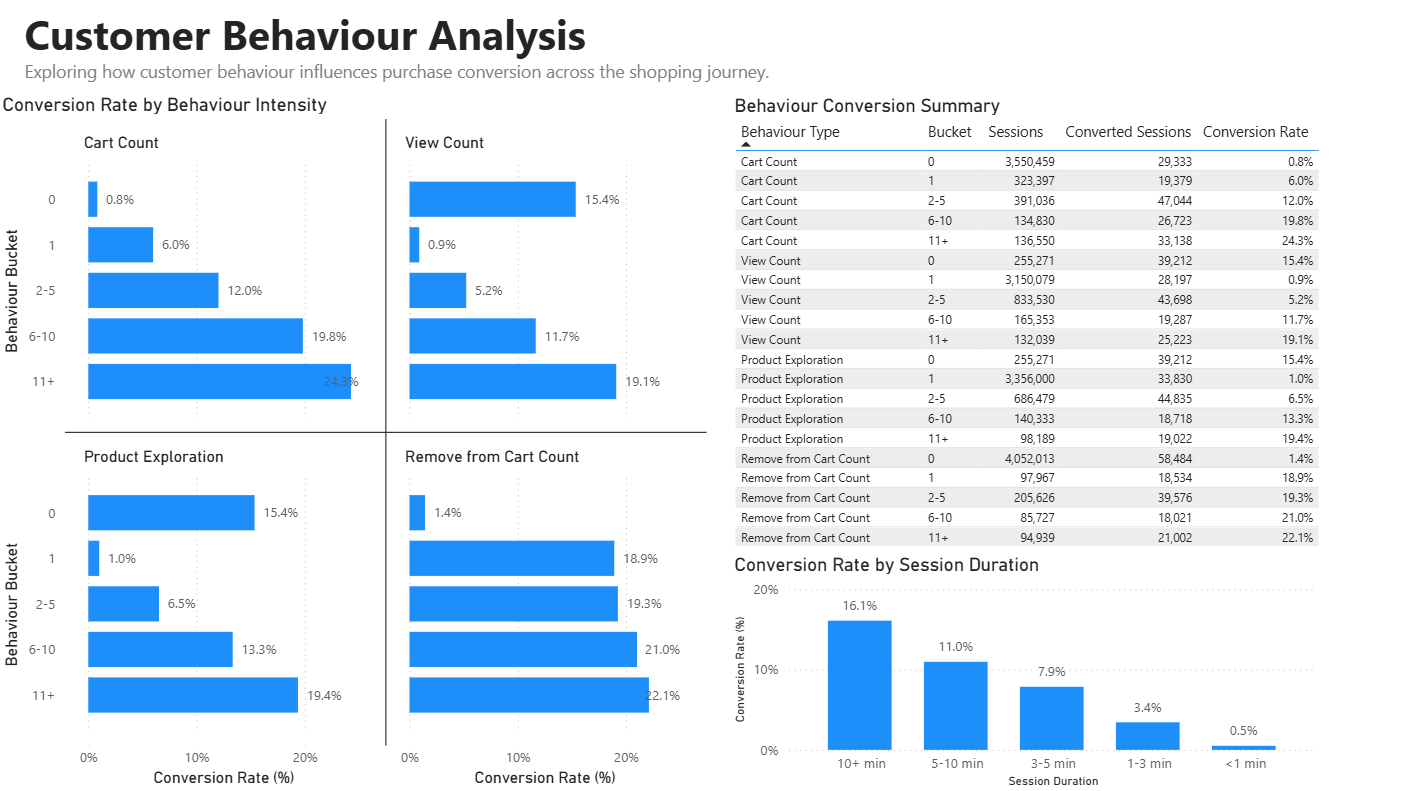
Conversion reaches 24.3% for sessions with 11 or more cart events and 19.4% for 11 or more product explorations.
High activity identifies intent. It does not prove that increasing activity will cause conversion.
Use high-intent and high-exploration segments to define test audiences.
Why this visual exists. Each analytical pattern is translated into a specific commercial action area.
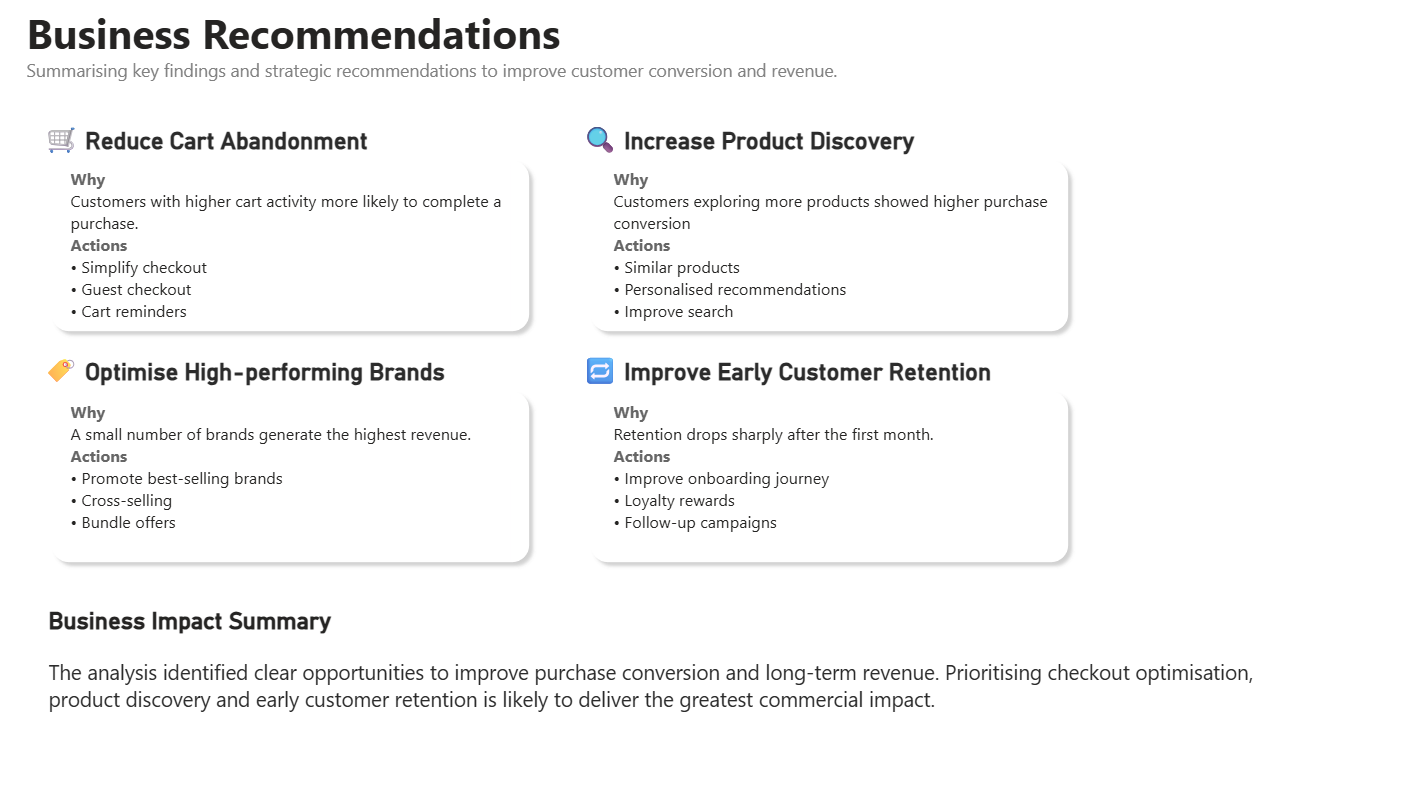
The analysis points to checkout friction, product discovery, brand concentration, and early retention as distinct opportunities.
A recommendation remains a hypothesis until a controlled test measures uplift and guardrails.
Convert each action area into a test with one primary metric and explicit risk checks.
Why this visual exists. Opportunity size, expected uplift, revenue range, sample need, and decision rules are shown together.
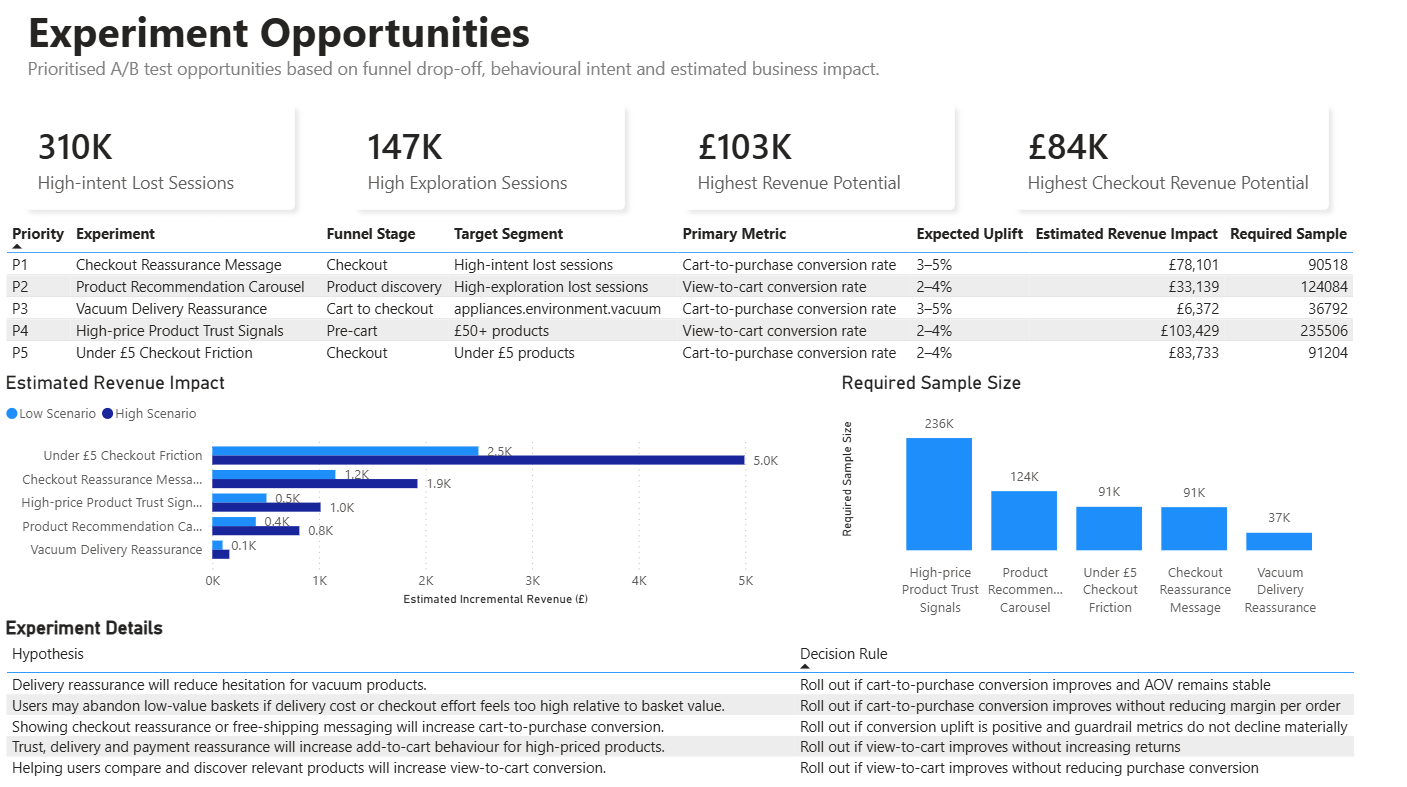
The roadmap contains five tests. High-price trust signals have the highest directional revenue potential at about £103K, but require the largest sample.
Potential value alone does not determine priority. Feasibility, sample size, and guardrails change the order.
Start with a feasible segment, then roll out only when conversion improves and the stated guardrail remains stable.
Source: original Power BI screenshots from the project repository. This is a personal portfolio project; revenue figures are estimates, not actual business revenue.
Related concepts
Journey
Metrics
Method
The query isolates non-buyers with meaningful cart activity and removes extreme sessions before the segment is used for test design.
CREATE TABLE high_intent_lost_sessions AS
SELECT user_session, user_id, session_duration_minutes,
       cart_count, unique_products_interacted,
       cart_abandoned_flag
FROM session_journey
WHERE converted_flag = 0
  AND cart_count BETWEEN 3 AND 20
  AND session_duration_minutes BETWEEN 1 AND 180;
The filters remove extreme sessions before the audience is used for test design.